

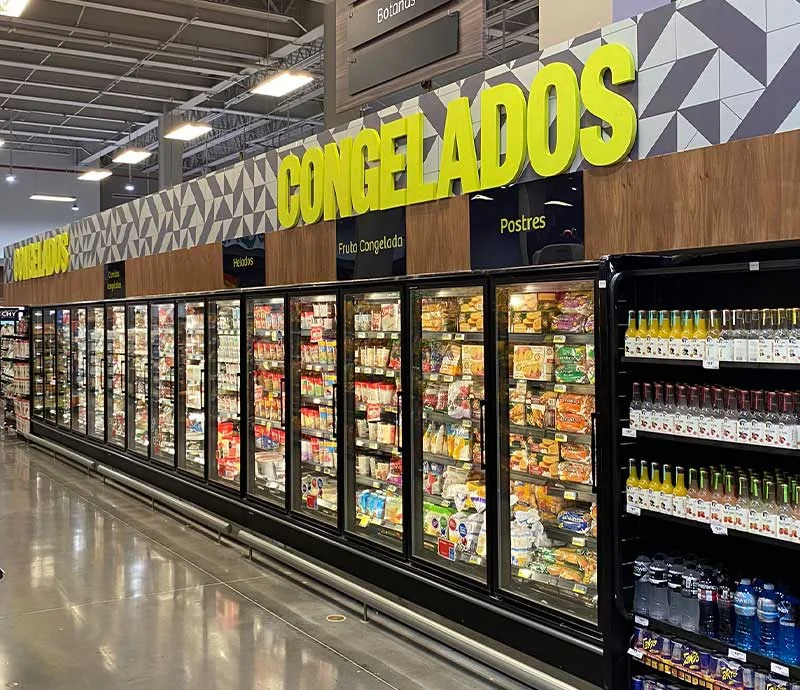
In-store signage and printed signage in the supermarket to improve visual communication
Informative signage in the supermarket is a discipline focused on the use of visual communication techniques aimed at creating signs with direct, clear and explicit information for the shopper.
Signage is widely used to provide important information to customers about products, prices, promotions and/or discounts, among other relevant aspects of their supermarket shopping journey.
In an environment as competitive as today’s, where winning over the customer in the supermarket is increasingly difficult, visual communication and signage play a fundamental role in growing sales.
It is no longer just about informing — signage and printed signage in supermarkets work to communicate brand, product or promotions, inform, identify and create the atmosphere of certain categories, or highlight a section and delimit a zone, with the clear goal of growing sales.
What are signage and printed signage in the supermarket for?
We could talk about three specific situations when speaking of informative signs and posters.
- Information for the customer: communication through signs is very effective and can be placed in many spots: floors, shelves, aerial, ceilings, etc.
- Marketing: Good signage and visual communication in the supermarket helps build visual identity and lets customers identify and remember the messages much better, encouraging purchase and later loyalty.
- More sales and more customers. All the signage and printed signage used on shelves, promotional signs, offers, etc., draws customers’ attention and encourages them to engage and buy, so they can be seen as an acquisition tool.
Main communication and signage elements in the supermarket
There are many types of signage and printed signage for points of sale and supermarkets, and all of them help to communicate the brand image and prices, make customer navigation through the point of sale easier and, of course, grow sales.
Some of the most important elements for a supermarket are:
1. Communication and signage on and off the shelf
Shelf profiles are one of the best supports to show customers the information they need. You can find this type of communication for both paper labels and electronic shelf labels, and both report in detail on aspects such as product descriptions and prices.
There are many types of supports to signpost or communicate in-store, and depending on the location, available space and communication objective, you can find different adaptable and customisable solutions.
This kind of in-store signage adapts to the point-of-sale fixtures and is easy to install, offering customers featured, useful information about recommended products, offers and promotions, new arrivals and product qualities, while also supporting staff operations in-store.
The range of communication and signage solutions with commercial objectives that can be found within the shelf and located in different areas is very wide:
- Displays
- Stoppers
- Shelf strips
- Shelf wraps
- Delimiters
- Promotional windows
- Trays
- Prisms
- Etc.
Although they can also be placed off-shelf:
- product displays
- floor vinyls
- alarm covers
- pallet wraps
- decorative rolls
- totems…
2. Perimeter and exterior printed signage
We also find different printed signage elements in supermarkets that make the most of every space in the point of sale to inform the customer.
There are solutions, for instance, to help locate an area, section or universe, and to guide the customer along the journey through the store:
- vinyls
- aisle markers with boards
- kakemonos
- light shades…
Printed signage is one of the ways to attract the customer and make their shopping experience satisfying — and that will shape their feeling and direct opinion of the point of sale. Through communication, we can connect with the customer and influence, to a greater or lesser extent, their final buying decision.
There are different solutions for the interior, such as:
- wall signage
- perimeter awnings
- gondola ends
- 3D letters
- etc.
And also for the exterior, you can find options such as:
- vinyls
- banners
- signboards
The combined set of solutions will be able to attract and retain the customer and shape the way they experience their shopping journey.