

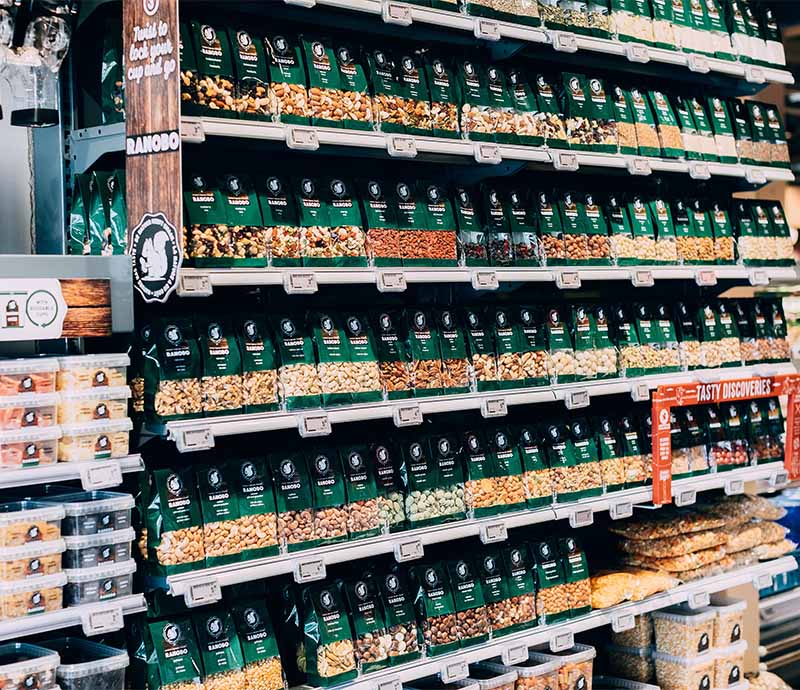
How to place products in your supermarket: strategies to grow sales
Have you ever stopped to think how many decisions a customer makes in the aisles of your supermarket?
Most of those decisions are not planned — they are made in just a few seconds, influenced by what shoppers see, how they see it and where they see it.
That is why understanding how to place products in a supermarket is one of the most important keys to improving your sales. It is not just about filling the shelves: you need a good product placement strategy that invites buying.
The importance of where you place products
When you walk into a supermarket, your attention does not spread randomly. There are hot and cold zones, levels of vision and key aisles.
Understanding these concepts lets you anticipate consumer behaviour and, with that, improve your ability to drive more supermarket sales in a simpler and more profitable way.
The most valuable zone is eye level. Products placed there are up to 35% more likely to be bought than those at floor level or far above eye level.
The same happens with gondola ends — a prime space for boosting new launches or promotions.
So if you want to know how to display your products in your supermarket, start by identifying the highest-traffic spots, the best visibility levels and the busiest moments.
Every decision about location can make a meaningful difference to your daily results.
Order, facing and categories: keys to activating sales
Beyond physical location, there is a fundamental element in a product display strategy: keeping shelves tidy and well-faced to grow sales.
This principle, which seems basic, has a direct impact on the consumer’s perception of quality, availability and care.
When a customer sees an untidy shelf with gaps or poorly placed products, they unconsciously read that product as low-rotation or low-demand.
On the other hand, a clean, full, perfectly aligned shelf conveys dynamism, trust and professionalism. Proper facing — always showing the visible face of the product towards the customer — is not just aesthetic, it is a selling technique.
And do not forget the power of category grouping. If you place complementary products together (such as pasta, sauces and grated cheese), you increase the chances of cross-selling.
This kind of strategic product placement in your point of sale also helps trigger impulse purchases, improving the shopper experience.
How to place products on the shelf to highlight them and grow sales
Let us look at some practical guidelines you can apply from today.
- Eye level = sales level. Place your hero products or those you want to rotate fastest in this area.
- Group by colour and size. This makes visual navigation easier and avoids “noise” on the shelf.
- Use clear signage. Discounts, special prices or featured products must be easy to identify from a distance.
- Make the most of the ends. Aisle ends are spots with very high potential.
- Refresh the display regularly. Change the location of certain products every two weeks to refresh the experience.
And how do you place products in your supermarket if you have many SKUs or limited space?
By prioritising. Not everything can be in the best spot, but you can rotate, run A/B tests with placements and observe what works best.
What matters is leaving nothing to chance.
Impact of a good placement strategy
Applying these techniques properly does not just improve sales — it also directly influences how the customer perceives your store.
Good organisation inspires trust. Order creates a more comfortable experience. And the right visibility can take a product from being stagnant to becoming a top seller.
What is more, if you know how to position your products in the supermarket using the customer’s logic — not just the supplier’s — you will see loyalty grow.
People come back to places where they easily find what they are looking for, where they discover new things effortlessly and where they feel there is a clear logic behind every display.
As you can see, strategy is essential. Do not underestimate the power of a few centimetres up or down, or of a well-placed label. In retail, the small details sell more than you imagine.