
Electronic shelf labels vs paper labels: why stores are making the switch
If you have ever walked through a supermarket or an electronics store and noticed the price labels, you have probably spotted something. There are more and more digital labels on the shelves.
Why is this shift happening? Is it really worth it for retailers to replace paper labels with electronic ones?
Today we are going to look at a clear and straight comparison of this change in retail labelling.
We are going to analyse their benefits, how they work and why so many stores are betting on smart labelling.
How to optimise price management with digital solutions?
In-store labelling has evolved over time.
We went from writing prices by hand to printing labels in bulk. And now, with the arrival of labelling and visual communication solutions for the point of sale, digitalisation is making a big difference.
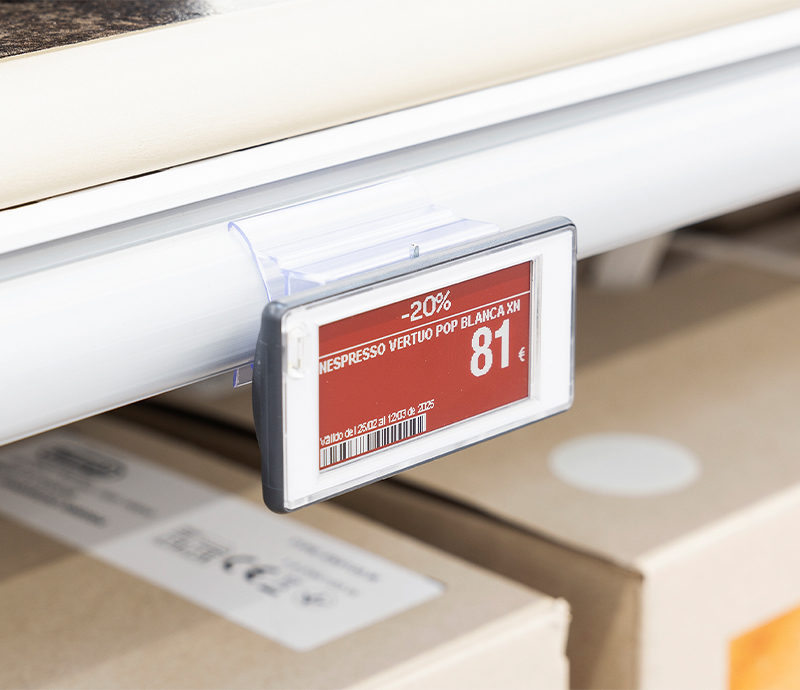
Electronic shelf labels (ESL) for retailers let you update prices in seconds, without having to manually replace paper labels.
Just imagine a store with thousands of products. How much time and effort do you save if you can change prices with a single click?
But that is not all. Beyond efficiency, electronic labelling brings very clear advantages such as:
- Greater price accuracy. It avoids human errors and discrepancies between the checkout price and the shelf price.
- Real-time updates. It syncs prices automatically with the management system.
- Less paper waste. A more sustainable, eco-friendly alternative.
- A better customer experience. Clear, up-to-date information improves trust in the purchase.
How do electronic shelf labels work?
If you are not yet sure how electronic shelf labels work, we can tell you it is simpler than you might think.
These digital labels are connected to a central system that lets you change prices or product information in seconds.
Key components of an electronic shelf label:
- E-ink or LCD screen: shows the price and other product data.
- Wireless connectivity: syncs with the store system via Wi-Fi or NFC technology.
- Long-lasting battery: can last for years without needing to be replaced.
- Interactive features: some include QR codes, app integration or even notifications for customers.
Thanks to these elements, stores can manage their catalogue more efficiently and without errors.
Electronic shelf labels vs. paper labels
Electronic shelf labels are rapidly replacing paper thanks to their efficiency and accuracy.
While updating prices on paper labels takes time and is prone to errors, electronic labels do it automatically in seconds.
In the long run, even though ESLs have a higher initial cost, they save on printing and labour, while paper labels generate recurring expenses.
What is more, smart labelling reduces waste and improves the customer experience by adding extra information, such as QR codes or reviews.
Digitalisation is undoubtedly the future of retail, which is why more and more stores are opting for this solution to optimise their management and improve competitiveness.
So it is easy to see that electronic shelf labels represent a more modern and efficient solution.
Benefits of smart labelling in retail
If you still have doubts about implementing electronic shelf labels in your point of sale, here are some of the main benefits convincing stores to take the digital leap:
1. Lower operating costs
Updating paper labels manually takes time and resources. With a digital system, staff can focus on improving the customer experience rather than swapping labels.
2. Greater flexibility in pricing strategy
Stores can apply discounts or promotions instantly, without waiting for the sales team to replace labels — ideal for dynamic pricing strategies.
3. Integration with e-commerce
Electronic shelf labels can display extra information such as customer reviews, price comparisons or nutritional data via QR codes or NFC technology.
4. Improved shopping experience
Customers find up-to-date prices and can access extra product information in real time, which increases their trust in the purchase.