

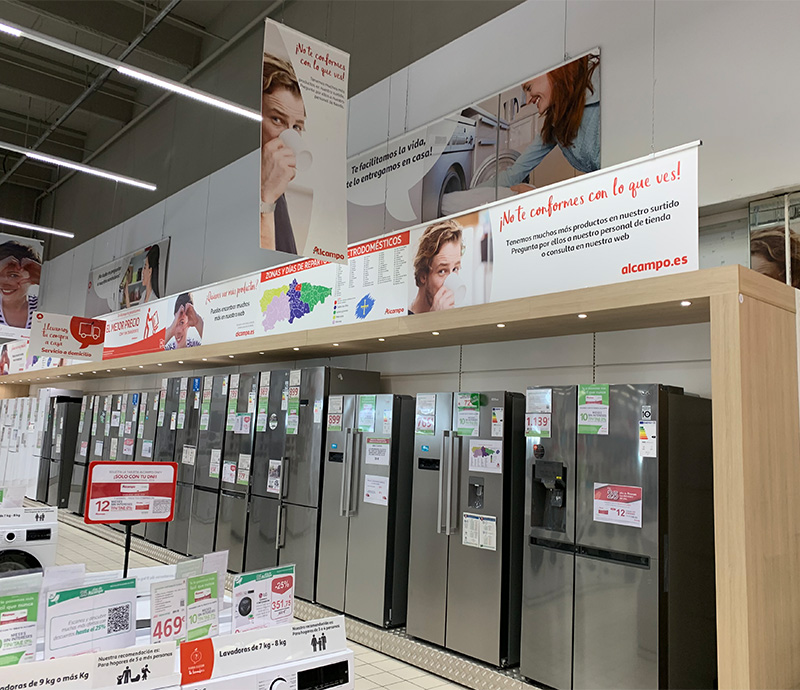
Make your products stand out: effective POP strategies for the point of sale
Point-of-purchase advertising (POP) is key to catching customers’ attention right when they are making their buying decisions.
Especially in retail, having a strong POP strategy can make the difference between your product going unnoticed and becoming the customer’s preferred choice.
Today we want to share a guide so you know how to implement POP strategies that boost your in-store results.
Why is POP advertising so important at the point of sale?
Point-of-sale advertising is not just about placing eye-catching materials — it is about knowing where and how to use them so the customer notices and values them.
Imagine walking into a store full of products. By default, those with an attractive display, clear messages and a strategic location are the ones that will grab your attention most.
That is the essence of POP: getting the customer to stop and look at your products, spark interest and motivate them to take a favourable buying decision.
- Customers who receive positive visual impacts thanks to POP products are helped to remember the brand.
- A well-developed POP strategy boosts your brand image and consolidates its presence at your point of sale.
- A good in-store display will undoubtedly increase the likelihood of purchase among your potential customers.
POP strategies you can implement
There are many ways to implement POP advertising effectively. Here are some of the most outstanding you can try.
1. Eye-catching, well-positioned displays
Displays are essential in any POP strategy. Placing them at strategic spots in the store, such as the entrance, the end of aisles or near the checkout, increases their visibility.
Make sure your display designs are consistent with your brand identity and feature the colours, logos and messages you want your customer to remember.
For example, you can use displays of different heights and shapes to capture visual attention. A vertical display may work better in walkways, while a horizontal one at the checkout area invites impulse buying.
2. Signage and messages that guide the customer
Clear, attractive signage at your point of sale is an effective way to lead the customer to your products.
Signs and labels are ideal for communicating specific benefits, such as “Special offer” or “New“, and even for highlighting product features such as “100% organic” or “Last units“.
This type of communication not only smooths the customer’s journey through the store but also gives them valuable information to make a decision.
Important: when using signage POP strategies, go for bold colours and concise messages that are easy to read from a distance.
3. Interactive experience zones
Interactive experience zones are a trend in point-of-sale marketing, because they invite the customer to try your product before buying it.
This type of POP is ideal for categories such as cosmetics, food or electronics, where direct interaction increases the likelihood of purchase.
Bear in mind that customers who try the product or interact with it feel more confident and are more likely to buy it.
4. Digital advertising at the point of sale
More and more, POP marketing is going digital. From interactive screens to tablets on shelves, digital resources let you show extra product information and even personalise the shopping experience.
Promotional videos or tutorials on screen, for instance, catch attention and engage customers in a dynamic, attractive way.
5. Build an effective POP strategy with practical steps
Implementing effective POP strategies takes planning and optimising every step.
Here are some practical examples to develop your point-of-sale advertising strategy.
- Define what you want to achieve. Before designing any material, be clear about what you want from your POP. It could be boosting a specific product, raising the average basket or building loyalty for a specific brand.
- Pick the right products. Not every product requires the same exposure. Choose those with high impulse-purchase potential or those that need a boost in their presentation.
- Place your POP strategically. Locating POP in high-traffic spots is essential — studies show that entrance and exit zones, checkout areas and aisle ends are the hot spots for placing POP that is truly visible.
- Evaluate and measure. Point-of-sale advertising is not static. Always measure the results of every action, analyse whether they are achieving their purpose and adjust your actions according to the metrics you get.