

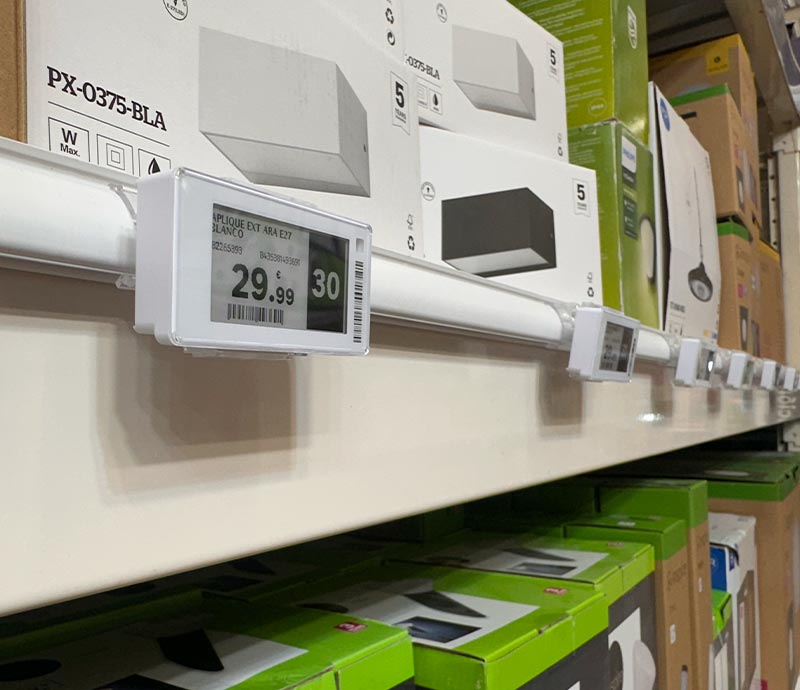
How to implement digital price signage in stores and points of sale
Price signage at the point of sale is one of the most important elements to guarantee a smooth and satisfying shopping experience.
But what happens when prices change constantly, products run out or you need dynamic promotions?
This is where digital price signage comes in — a solution that does not only modernise your point of sale, but also optimises price management and improves the customer experience.
Today, in this article, we will see how to implement this technology in your point of sale, step by step, and the benefits it can bring you.
What is digital price signage and why should you consider it?
Digital price signage is a system that lets you update your product prices automatically and in real time.
Imagine that, instead of printing and manually placing price labels every time something changes, you can update all the information from a centralised platform.
This system not only saves time but also reduces human errors, such as labelling a product with the wrong price.
It also lets you implement dynamic pricing strategies, adjusting your rates based on demand, the competition or current promotions.
Benefits of digital signage
Why should you invest in this kind of technology?
Let us look at some benefits of digital signage that will make you think twice.
- Real-time updates. Change the prices of hundreds or thousands of products in seconds. Ideal for flash promotions or inventory adjustments.
- Lower operating costs. Forget about printing price labels over and over. In the long run, this means significant savings.
- Better customer experience. Clear, up-to-date prices build consumer trust.
- Flexibility and scalability. You can start with a small section of your store and expand the system as your needs grow.
How to implement digital price signage in your store
Now that you know the benefits, let us look at the implementation process.
1. Assess your needs
Before rushing to buy any system, it is crucial to analyse the specific needs of your business.
- How many products need price labelling?
- How often do your prices change?
- What integrations do you need with your inventory management software?
Ask yourself these questions to define the project scope and pick the solution that best fits you.
2. Choose the right system
Not every digital signage system is the same.
- Some offer advanced features such as integration with dynamic pricing platforms or real-time data analytics.
- Others are more basic, but still effective for small stores.
Research, compare and pick a reliable supplier who offers technical support and a warranty.
3. Train your team
Make sure your team is well trained and knows how to use the new system.
Explain how it works, how to make updates and how to handle basic troubleshooting.
4. Test before launch
Before rolling the system out across the whole store, run a pilot in a small section so you can spot possible errors and tweak details before scaling up to your whole point of sale.
5. Monitor and optimise
Once the system is up and running, you have to analyse and tweak it constantly. Monitor results, analyse customer feedback and adjust whatever is needed.
Digital price signage is a very important tool, but its real potential is unlocked when you use it strategically.
Key challenges in digital price signage
First, involve your whole team from the start, explain the benefits to them and offer ongoing training.
Another challenge is the initial cost. Yes, it can be a significant investment, but remember that in the long run the operational savings and sales benefits justify the spend.
And do not forget: to get the most out of it, integrate your digital price signage system with other tools such as your inventory management system, your dynamic pricing platform or your data analytics system.